What Happens To Your Trash When It Leaves Your Dumpster? A Complete Guide To The Trash Journey
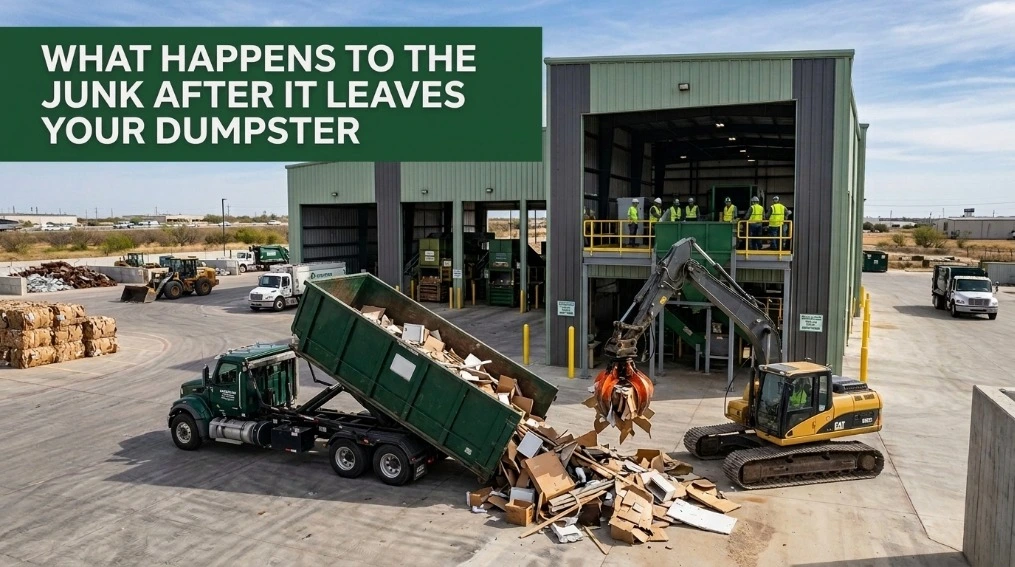
You fill the dumpster, we pick it up, and that’s usually the last thing most people think about. But your debris doesn’t just disappear once it leaves your property. It goes through a real disposal process first. Understanding where your waste goes after dumpster pickup can actually help you load smarter and avoid extra fees. The truck doesn’t drive straight to a landfill. It stops at a transfer station first, where your load gets weighed, unloaded, and sorted.
From there, it splits off depending on what’s inside. Clean wood, metal, and cardboard usually get pulled for recycling, yard waste can be composted, and everything else, roughly half of what’s thrown away in the US, ends up buried in a landfill. What you load, and how you load it, plays a bigger role in where it ends up than most people think.
How Your Dumpster’s Contents Get Collected and Sorted
Pickup
At the time of picking up your dumpster, the truck does not go directly to the landfill; instead, it visits a transfer station first, a stop that usually takes place within a few hours of the pickup, not days afterwards. At the transfer station, the entire shipment is weighed on a scale, then dumped out and inspected before it is sent anywhere else.
This step has been included since it is cheaper and quicker to combine the loads from several trucks and send them out together than it is for each dumpster truck to make the complete journey to the landfill or processing facility. Moreover, some transfer stations remove the recyclable materials and any hazardous items before the rest of the material continues.
Transfer Stations and Material Recovery Facilities
Whether the material goes directly to a landfill or is first sent to a material recovery facility (MRF) depends on the contents of the load and on what your hauler provides.
At material recovery facilities, debris is carried along by belts and passes by magnets, screens, and workers who sort it by hand. The clean and separated materials are then processed quickly, while mixed loads such as those obtained from a construction cleanout or a complete house declutter require more work to sort, and not all of them come out the other side as something that can be recycled.
For anyone who is renting a dumpster, the most important thing to realize is that even when the waste is mostly made up of useful materials, it can still be sent to a landfill if it has become contaminated, if it has been mixed with unsuitable materials, or if the facility is not able to separate it. Useful materials like clean wood, scrap metal, and cardboard are most likely to be recovered, while wet drywall, mixed plastics, and anything soaked in paint or chemicals generally aren’t.
Where It Ends Up
After sorting, the materials are sent to one of four destinations. Recyclable items such as wood, metal, and cardboard are generally taken to a recycling plant. If there is a composting site nearby, garden waste and organic matter can be taken there. A portion of the material is burned at a waste-to-energy plant, which reduces its volume considerably, although this is not really disposal in the traditional sense. The remainder, about half of all the waste thrown away nationally according to EPA estimates, ends up in a landfill. The same recycling process is not applied to all the things that are put into a dumpster. The following explains what generally occurs to the most common kinds of waste people discard.
What Happens to Different Materials in Your Dumpster
Not everything you toss in gets treated the same way once it leaves your property. Here’s what actually happens to the most common stuff people load up.
Wood:
Untreated wood used for framing, pallets, and trim is generally recycled or is shredded into mulch. Treated or painted wood is an exception to this rule since most recycling facilities will not accept it, and so this kind of wood usually ends up in the landfill.
Metal:
It is the most desirable kind of recyclable material; scrap metal includes things like steel, aluminum, copper wiring, and old appliances, essentially anything you can think of. Since both haulers and recycling facilities are interested in it, the scrap metal is separated and kept.
Cardboard and paper:
Dry cardboard can be recycled, but if it gets wet or greasy, then it ends up like all the other things do, in the landfill.
Drywall:
With regard to drywall, if it is clean, some facilities may recycle it either into new drywall or use it as a soil amendment, but many of the smaller operations don’t have the necessary equipment to carry out such recycling. Drywall that is wet or mouldy will almost certainly not be recycled.
Concrete, brick, asphalt:
It consists of concrete, brick, and asphalt and is usually sent to a dedicated crushing plant where it is turned into roadbed material or fill dirt. Since most dumpsters have weight restrictions, there can be considerable costs involved in removing large quantities of this material.
Shingles:
If your nearby facility has the ability to process shingles, then in some cases it is recycled into asphalt or paving material.
Yard waste:
Branches, leaves, and grass clippings can go to a composting facility if there’s one nearby. If there isn’t, it just goes to the landfill and breaks down without oxygen, which produces methane.
Furniture and household goods:
Depends on the shape it’s in. Some haulers will pull out furniture that’s still in good condition and donate it, but most of it ends up in the landfill since there’s really no recycling option for upholstered or mixed-material pieces.
Batteries, electronics, paints:
These shouldn’t go in the dumpster at all. They’re a fire risk at the sorting facility, and they need to go to a hazardous waste or e-waste drop-off instead.
Types of Landfills
Not every landfill takes the same stuff. There are four main kinds you’ll run into in the U.S.
Municipal solid waste landfills.
This is where most household trash and dumpster loads end up. By far the biggest category.
Construction and demolition landfills.
These handle concrete, wood, drywall, and demo debris. A good chunk of it actually gets reused or crushed down into fill material instead of just sitting there.
Hazardous waste landfills.
These are tightly regulated and built specifically for materials too dangerous for a regular landfill.
Inert landfills.
Just dirt, sand, and rubble here- stuff that won’t break down or react with anything. This is why dumpster companies ask what you are throwing out before telling you the price.
Concrete and demo debris go to a different place than regular household junk. Mix the two, and you’re looking at extra fees, or the whole load could get turned away.
How Long Does Trash Actually Take to Break Down?
Most people figure everything in a landfill eventually just rots away. It doesn’t really work that way, and how long it takes depends a lot on what you’re talking about.
Based on commonly cited estimates, food scraps are gone in a few weeks to a few months. Paper takes about a month or so. Cotton fabric can hang around for close to a year. Aluminum cans stick around for 80 to 200 years. Plastic bottles take over 450 years. Glass pretty much never breaks down
That’s assuming normal conditions: air, oxygen, the kind of setup you’d see in a compost pile. A landfill isn’t that. Everything gets packed down tight and buried under fresh dirt every day, which chokes off the oxygen and slows everything to a crawl. People digging into old landfills have actually pulled out newspapers from decades ago that were still readable.
That’s a big reason methane capture matters so much. Buried organic waste breaks down without oxygen and releases methane, and many newer landfills now capture that gas and turn it into energy instead of letting it leak out.
Where Does Waste From New Braunfels Actually Go?
If you’re renting a dumpster in New Braunfels, your debris follows the same basic path as anywhere else, just with a few local details worth knowing.
Most of what gets hauled away ends up at Mesquite Creek Landfill, off Kohlenberg Rd. It’s run by Waste Management and handles a big chunk of the waste coming out of the stretch between Austin and San Antonio, so it’s not just New Braunfels trash piling up there.
If you’d rather drop off recyclables yourself instead of waiting on pickup, the Comal County Recycling Center on Resource Dr. takes materials outside of normal collection. One thing to know, though: mattresses and box springs don’t go through regular bulk pickup here. Instead, those materials are sent over to Texas Recycle Warehouse in San Marcos. Having this information beforehand is super helpful when you’re figuring out what size dumpster you need and what you can actually throw in it. This is especially true for larger projects like renovations or complete property cleanouts, where you’re often handling a variety of materials.
Frequently Asked Questions
Does everything in my dumpster actually get recycled?
Not everything. It really depends on what is inside the dumpster and how clean it is when it gets sorted. If there’s too much of the wrong stuff in it, that load usually ends up in the landfill instead.
What happens if I throw something in that’s not allowed?
It really depends on what you throw in. Some items will simply be fished out and sent straight to the landfill. However, if you throw in things like batteries or chemicals, that can cause some serious problems at the sorting facility, and they might end up rejecting your entire load.
Does trash really not break down in a landfill?
Not quite, and it takes a lot longer than you might expect. The waste gets packed in tightly and is covered with dirt daily, which means there’s barely any air getting in. Even paper, which usually decomposes pretty fast when it’s out in the open, can linger for years once it’s buried underground.
How long does it take for a plastic bottle to break down?
Plastic bottles stick around for ages; most estimates say over 450 years. Glass bottles are even worse, in fact; some believe that they never really break down.
How far does my dumpster’s load actually travel after pickup?
That depends entirely on where you live. Sometimes the landfill or transfer station is only a few miles away. But in other spots, your trash could be hauled more than 100 miles to reach the nearest facility.
Is a full dumpster more expensive than a half-full one?
Not really; rental prices usually depend on size and weight. Not how packed it looks, but if you go over the weight limit, you will definitely pay extra fees.
Does the recycling symbol mean something is accepted?
No. That symbol just tells you what kind of plastic it is, not whether your local facility will actually recycle it.
Does trash end up in the ocean?
A lot of people worry about this. If you use a dumpster or landfill the right way, that trash usually stays put. Ocean debris mainly comes from littering and illegal dumping.
Is waste-to-energy a better option than landfilling?
Both options have downsides. Waste-to-energy plants can slash waste volume and create energy, but burning trash releases emissions. Neither route is perfect. The real fix is to produce less waste and recycle from the start.
Can I toss dirt or concrete into a regular dumpster?
Sure, you can, but it’s not always the best choice. Dirt and concrete are heavy, so you will hit the weight limit fast even if your dumpster isn’t visually full. Most companies offer a dumpster made for heavy debris; choose one of those, and you will probably avoid extra fees.
What happens if it rains before my dumpster is picked up?
Rain tracks extra weight into your load, and you will pay for it. Wet stuff like drywall, wood, and cardboard is hard to recycle, so more ends up in the landfill. If you want to skip unnecessary fees, cover your dumpster or schedule your pickup when the weather is clear.
Wrapping Up
Your trash doesn’t vanish when the dumpster leaves. It goes to a transfer station and gets sorted. Some are recycled, composted, or turned into energy; the rest heads to a landfill. In the US, almost half of waste still ends up in landfills, and a lot comes down to how you packed the dumpster. If you sort recyclables, keep out prohibited items, and know what your local facility accepts, you give your trash a much better shot at being reused.
So, if you’re tackling a cleanout, renovation, or job site in New Braunfels, picking the right dumpster and knowing what to toss makes a difference. It’s not just about weight; it’s about where your waste ends up.