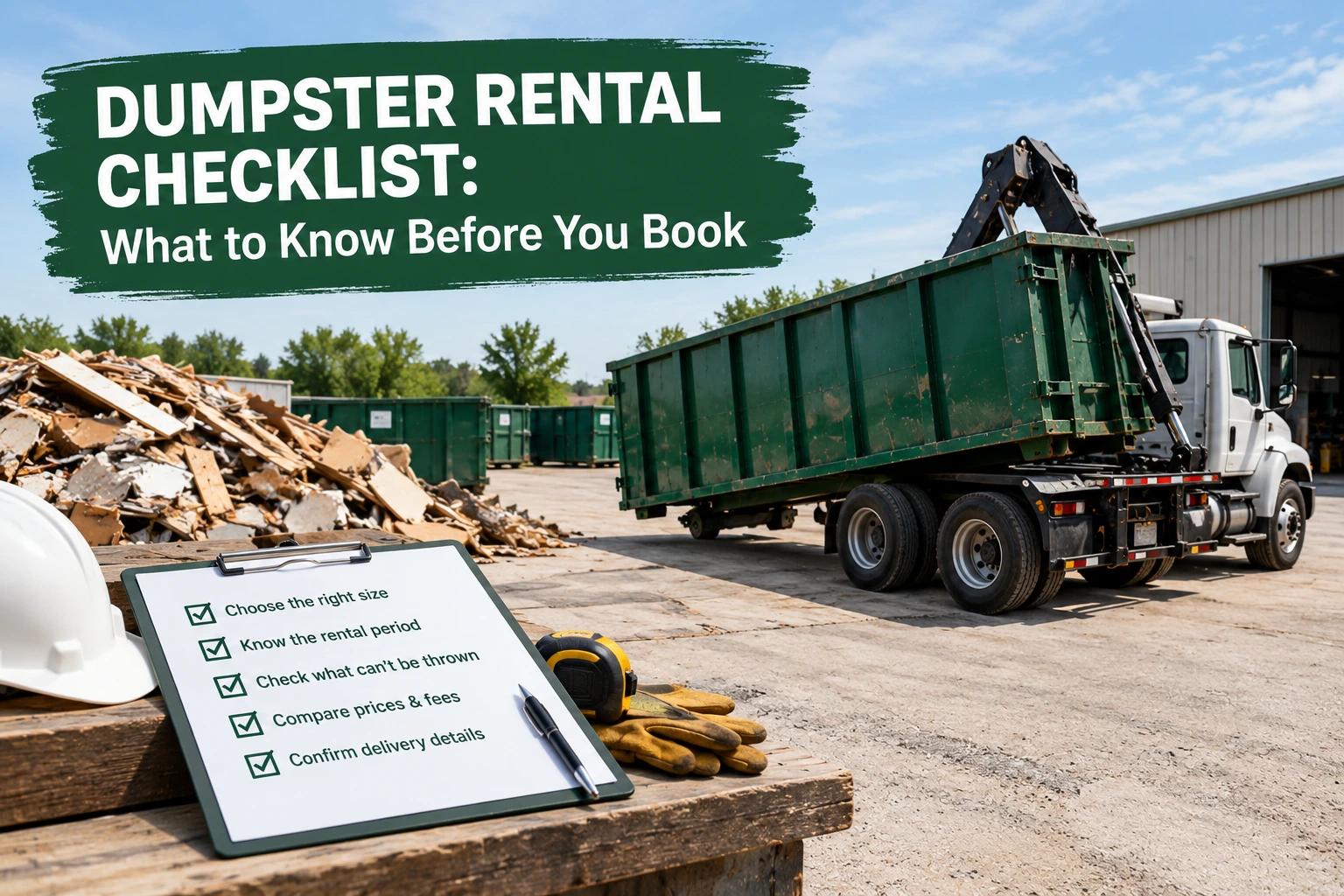
Dumpster Rental Checklist: What to Know Before You
At first, renting a dumpster seems simple enough, but when the truck turns up, there’s a problem: it could be that the dumpster is too small, or it might have already been full before you had even gotten halfway through, or perhaps the pickup time was scheduled a bit too soon. Although the specific issues may vary, they all usually come to the same point: the details weren’t fixed before the booking was made.
Spending just a few minutes getting ready before you make the call can prevent you from having to pay extra fees, carrying out a second trip, or leaving your dumpster empty in the driveway longer than necessary. Below is a list of all the items you should check first.
Key Points
- Choose a size based on your project and debris. A 10 or 15-yard works for a garage or one room, and big renovations need a 30 or 40-yard. If you’re stuck between two sizes, go bigger.
- Know the weight limit. A 10-yard usually allows 1 to 2 tons, and a 20-yard about 2 to 4 tons. Concrete, dirt, and shingles can hit that limit before the dumpster looks full.
- Ask what the quote covers, including delivery, pickup, disposal, overage, and late fees. Vague answers are a red flag.
- Most rentals run 7 to 10 days, and they usually don’t allow paint, batteries, tires, or appliances with refrigerant.
- Measure your space and check for a permit. A 15-yard dumpster needs about 8 feet of width, and a street placement can need a permit costing $20 to $150.
Points to Remember Before You Book
Know Your Project Type
All dumpster companies will want to know what kind of project you are involved in since this enables them to decide on the appropriate size and type of dumpster to recommend, making it a good idea to have a clear answer ready.
Cleanouts can be as small-scale as a weekend cleanout in the garage or as extensive as a complete home or estate cleanout. Roofing work can involve minor patch repairs or may require a full tear-off and replacement. For minor repairs or the cleanout of a single room, a 10 or 15-yard dumpster is usually sufficient, whereas larger jobs such as full renovations or a whole-home cleanout require a 30 or 40-yard container.
Know What You’re Throwing Away
The kind of debris is just as important as the quantity. Things that are lightweight, such as furniture, cardboard, and ordinary household items, take up space without adding much weight. On the other hand, heavy materials such as concrete, dirt, brick, or shingles have the effect that they can reach the weight limit long before the dumpster seems to be full.
Since a cubic yard of concrete weighs roughly the same as a compact car, mixing it in with ordinary household waste is one of the quickest ways of incurring an overage fee.
Pick the Right Size (Cubic Yards)
Dumpsters come in cubic yards, the most frequently used sizes being 10, 15, 20, 30, and 40; you can easily visualize one cubic yard as being about the size of a washing machine.
10-yard dumpsters are suitable for small jobs or for heavy kinds of debris such as concrete and dirt.
20-yard dumpsters work well for medium jobs like small renovations.
Dumpsters that are 30 and 40 yards in size are more suitable for large renovations, complete cleanouts, or work carried out in a commercial setting.
When you have to choose between two sizes, select the larger one since you’ll usually have to pay about the same amount but will then not have to arrange a second dumpster when the first one is full.
Understand the Weight Limit
It is here that the majority of surprise charges arise. When you rent a dumpster, there is a weight limit built into the price, and if you exceed it, you have to pay extra; the charge is generally made on a per-ton basis. As a general idea, a 10-yard dumpster usually permits 1 to 2 tons and a 20-yard dumpster about 2 to 4 tons. The figures may vary depending on the company and location, so it’s necessary to check the exact amount when you call.
The size of a dumpster doesn’t mean the same as its weight, and this is a common source of confusion. Although a 10-yard dumpster may seem as if it could only contain a small amount of rubbish equivalent to a few washing machines, it can still hold a couple of tons of concrete. When it comes to heavy materials such as concrete, soil, or tiles, you can reach the weight limit well before the dumpster appears to be nearly full.
Ask About Pricing and Hidden Fees
Before you book, make sure you have a clear answer regarding exactly what is included in the quoted price by asking the following questions.
- Delivery and pickup fees
- Disposal or environmental fees
- Overage charges if you go past the weight limit
- Extra charges for restricted or heavier-than-expected items
- Late fees if the dumpster stays past the rental period
A company that provides you with clear answers to all of these questions at the beginning is a positive sign; you should note the fact if you receive vague answers or if the price continues to change before you agree.
Lock Down Your Rental Timeframe
Most companies use a rental period that ranges from seven to ten days, even though this period can differ. In many cities, the number of days allocated for driveway placements is limited to about 30 per calendar year, which means that longer projects will have to plan for an extension in advance.
One of the most common errors made by renters is to end a rental agreement too early or to go beyond the deadline without informing anyone. If you already know that your project is likely to take longer, you should mention this at the time of booking rather than addressing the situation later.
Check Material Restrictions
It is not possible to dispose of all items in a normal roll-off. Items that are hazardous, such as paint, batteries, tires, fuel, appliances containing refrigerant, and asbestos, are generally prohibited and must be disposed of separately. Additionally, some companies either restrict the disposal of or charge extra fees for mattresses, electronics, or certain kinds of construction debris.
Before you take in anything doubtful, always check what has been excluded; it’s too late to find this out at the time of pickup, and that could result in the entire load being rejected.
Confirm Space Available
In order for the delivery truck to be able to safely drop off the dumpster and later pick it up, it needs a clear and unobstructed route. A 15-yard dumpster usually requires about 8 feet of width, along with some additional space on either side, whereas larger sizes may require as much as 12 feet.
Before the truck arrives, take measurements of your driveway or the area where the dumpster will be placed. When you book, make sure to note any sharp turns, low-hanging branches, or overhead wires, as these factors can influence whether the truck is able to get in.
It’s also worth considering whether the company lays plywood or boards underneath the dumpster since this distributes the weight and helps protect your driveway from cracking or denting, particularly in hot weather when the asphalt softens.
Find Out If You Need a Permit
Residential rental properties are not required to obtain a permit if the dumpster is completely on your own driveway or property, but a right-of-way permit is needed if the container is placed on or blocks public property such as a street, an alley, or a sidewalk.
The cost of permits usually ranges from $20 to $150 according to the city, and homeowners’ associations may have additional rules on top of those set by the local authorities. It’s worth making a quick check in either case since the fines for failing to obtain a required permit are generally higher than the permit fee itself.
Choose a Reliable Dumpster Company
The checklist mentioned above will only function if the company you’re hiring actually adheres to it. Before you make your booking, you should look for:
- Clear, upfront pricing with no vague “call for a quote” answers
- Good reviews and a solid local reputation
- Straightforward communication if your plans change
- Reliable delivery and pickup windows
A company that is easy to get to and honest about its prices will cause you less trouble than one that has a slightly lower price.
While the Dumpster Is On Site
Once it’s dropped off, a few habits make the rental period go smoother:
Load Heavy Items First
Put the heavy items first, at the bottom, since this keeps the load stable and makes it safer to lift.
Spread the Weight Evenly
Evenly distribute the weight; putting all of it on one side may result in the thing tipping over or make it more difficult to remove.
Stay Below the Fill Line
Go to the fill line; most companies will not accept a dumpster that is loaded above the rim, and anything that overflows will usually be left behind.
Cover it Well
If it’s going to rain, then cover it because a tarp will keep the water out, and a dumpster full of rainwater will weigh more, and that extra weight can push you over your limit.
Keep Your Rental Time in Check
Set your rental period to match your project. If possible, have it delivered right at the start of your project and collected right after you have finished. Each additional day that the item stays empty is a day for which you have to pay.
After the Dumpster Is Picked Up
Check the Spot
When the dumpster has been removed, quickly check the spot where it was positioned. Look for any remaining debris, tire marks, or damage to the surface, and immediately report anything unusual to the company.
Keep Your Paperwork
Make sure you keep your receipt, the permit documents, and the rental agreement in a place where you will be able to access them for a period of time. Although you will not generally need them again, they will save you a great deal of hassle if at any time there is a disagreement regarding the fees or the dates.
Frequently Asked Questions
Before you book a dumpster rental, what should I check?
First, work out the type of project you have and be honest with the company about the items you’re sending. Make certain you have the correct size, know the weight limit, and establish a time frame for the period that you’ll need it. Find out which materials are not permitted, measure the space to confirm it will fit, and check whether you need a permit, in particular if the item is to be placed on the street. Sort this out before anything else, and the rest of the process will go more smoothly.
What is it that makes me need a checklist before I rent a dumpster?
Most of these issues boil down to one single missed detail, rather than any intentional deception on the company’s part. If you take a minute to go through a short checklist, your rental experience will be a smooth-sailing affair, with no surprise bills tacked on at the end.
Do I have to have a location chosen before ordering?
Yes, pick your spot before you call. The delivery truck needs a clear path to reach it and enough room to drop the dumpster off safely. A 15-yard dumpster usually needs about 8 feet of width, and bigger sizes need more. If there’s a tight driveway, low branches, or anything else in the way, it’s worth measuring beforehand so there’s no issue on delivery day.
What if I don’t know if I am going to meet the weight capacity?
That’s common, so just let the company know. They can estimate the weight based on what you’re throwing away. Materials like brick, dirt, shingles, and concrete are much heavier per cubic yard than most household items.
Do I need a permit when the dumpster is on my driveway?
Usually, you will not need one when the dumpster is on your personal property. Most permits are required when your dumpster is placed on the street, on the sidewalk or curb area, or in an alleyway, or if your HOA has strict rules about what they will allow.
Will I be needed at the location for a delivery or pickup?
In most situations, your presence will not be required, so long as the dumpster has a clear location specified by you so that they know precisely where you’d like it dropped or picked up. Ensure both the direction of access and the location itself aren’t blocked.
What if my dumpster fills up before my designated rental period ends?
Most companies will let you have it swapped out for another full one if need be, though some will do early pickup and return with a brand new dumpster instead. Call to inform them rather than continue to pile junk over the brim.
What are the fees and conditions for exceeding my rental agreement?
You will more than likely be charged additional fees, either one lump fee or a day rate for each extra day you keep the dumpster. Simply call ahead and schedule an extension, if possible, to avoid all of that.
Will ordering the bin damage my property (driveway etc.)?
It can, especially on asphalt in hot weather or on soft, wet ground. Putting boards or plywood under the wheels and the dumpster itself spreads out the weight and usually stops it from sinking in or leaving marks.
Should I decide on my rental length before I call?
Yes, have a rough idea before you call. Most companies work with standard 7 to 10 day rentals, so knowing roughly how long your project will take helps you avoid calling back later to extend.
What is the cost of a dumpster rental?
It depends on the size you need, how long you’ll have it, and what you’re throwing away. Most residential rentals fall somewhere between $200 and $600, though heavy debris, extra rental days, or going over the weight limit can push that number higher. Give the company your specifics and ask for a quote to get an exact figure.
How far in advance should I book?
A few days out is usually enough for a standard dumpster. Book earlier if you’re ordering during a busy season, around a holiday, or need a specific size. Same-day or next-day delivery is sometimes available, but it’s not something you should count on.
Conclusion
Renting a dumpster isn’t complicated. Most problems come down to one thing: not planning ahead. Figure out exactly what you’re throwing away, ask about pricing and fees upfront so nothing surprises you later, and pick the size that actually fits your project.
Measure your space before you order, and be honest about your weight limit needs. Don’t book a longer rental than you actually need, but if you’re working with dirt, concrete, or other heavy debris, give yourself a few extra days of lead time since the bigger dumpsters can take longer to schedule.
Get these basics right, and the rest of the process goes smoothly. Reach out, and we’ll help you figure out the right size and timeframe for your project.